| Milk Reception and Transfer System |
Receiving
Filtration
Transfer
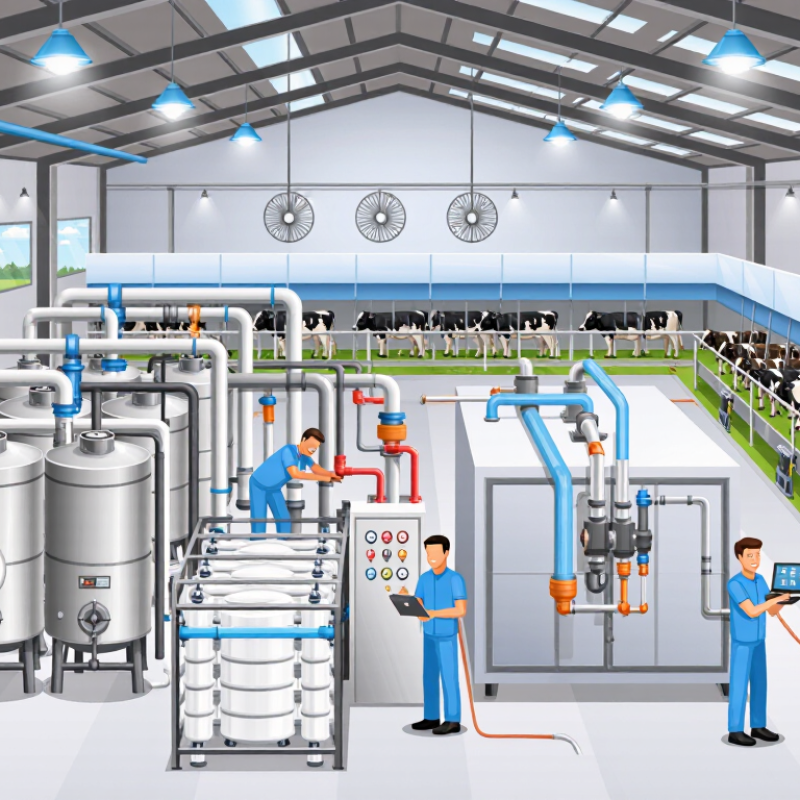
Designed for hygienic unloading, weighing or metering, pre-filtration, sampling, and transfer of raw milk. Pump capacity should match the tanker unloading rate and the plant’s peak processing demand.
|
Provide a level, washable floor with drainage and adequate access for tanker connections. Use food-grade hoses, sanitary fittings, correctly sized piping, and a short, drainable product route. Install temperature measurement and sampling points before storage.
|
Inspect hoses, gaskets, clamps, filters, pumps, and flow meters routinely. Replace damaged elastomers and filter media. Verify flow-meter accuracy and inspect for air leaks, product residues, and abnormal pump vibration.
|
Guard rotating pump components, control hose whip, and provide non-slip flooring. Use lockout/tagout during maintenance. Manage biological exposure to raw milk through hygiene procedures, protective clothing, and hand-washing facilities.
|
Maintain supplier specifications, material certificates, calibration records, cleaning records, and raw-milk receiving logs. Food-contact surfaces should be suitable for dairy use and designed for hygienic cleaning in accordance with applicable local food law.
|
| Refrigerated Bulk Milk Storage Tank |
2–10 m³ common range
Agitation
Cooling
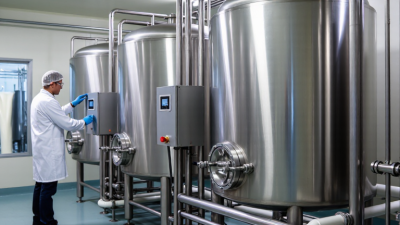
Used to hold raw milk under controlled refrigeration before processing. Final capacity should reflect delivery frequency, production volume, emergency holding time, and cleaning cycle requirements.
|
Install on a rigid, level foundation with service clearance around the tank. Provide sufficient refrigeration capacity, insulated product piping, a calibrated temperature probe, controlled agitation, and a drainable outlet. The tank room should have ventilation and floor drainage.
|
Check milk temperature, agitator seals, cooling performance, insulation, spray devices, and outlet valves. Clean and sanitize after each emptying cycle using validated time, temperature, chemical concentration, and flow conditions. Inspect refrigerant and electrical systems according to applicable rules.
|
Protect operators from agitator movement and hot cleaning solutions. Use emergency stops where required, prevent access through open manways during agitation, and control confined-space entry risks. Keep condensate and wastewater away from product areas.
|
Maintain temperature logs and cleaning validation records. Many food-control programs require rapid cooling and cold storage of raw milk; exact limits differ by jurisdiction, so buyers must confirm the applicable national or regional requirement.
|
| Plate Heat Exchanger Pasteurization Unit |
HTST processing
Heat recovery
Automatic diversion
Commonly used for continuous dairy pasteurization. A typical high-temperature short-time milk process uses approximately 72°C for 15 seconds, but the legally required process depends on the product and destination market.
|
Install with correct product-flow direction, balanced utility connections, adequate regeneration sections, sanitary valves, temperature sensors, a flow-control device, and an automatic flow-diversion valve. Provide access for plate inspection and gasket replacement.
|
Monitor differential pressure, outlet temperature, holding time, leakage, fouling, and gasket condition. Perform chemical cleaning after production as validated. Periodically inspect plates for pinholes and verify temperature and diversion-valve calibration.
|
Insulate hot surfaces, provide pressure relief where necessary, and protect operators from steam, hot water, and caustic or acidic cleaning chemicals. Interlocks should prevent unsafe operation when temperature, flow, or diversion conditions are outside limits.
|
Keep heat-treatment charts or electronic records, calibration certificates, validated holding-tube data, alarm records, and cleaning verification. Design and validation should support the applicable national pasteurization regulation and HACCP plan.
|
| Homogenizer |
Fat dispersion
Emulsion stability
High pressure
Used to reduce fat globule size and improve product uniformity. Selection depends on product type, flow rate, pressure requirement, viscosity, and whether one-stage or two-stage homogenization is needed.
|
Use a sanitary positive-displacement feed arrangement with stable inlet pressure and suitable pulsation control. Provide adequate clearance for valve, seal, and piston maintenance. Connect the machine to compatible electrical, cooling, and cleaning utilities.
|
Inspect homogenizing valves, seats, pistons, seals, bearings, lubrication, and pressure gauges. Follow the manufacturer’s service intervals for wear parts. Check for pressure instability, unusual noise, overheating, and product leakage.
|
Install guards and pressure-relief protection. Never loosen fittings while the machine is pressurized. Apply lockout/tagout before service and verify that all pressure has been released. Train operators on high-pressure injection and chemical hazards.
|
Retain pressure-setting records, calibration records, preventive-maintenance logs, food-contact material documentation, and cleaning validation evidence. The hygienic design should support the plant’s HACCP and prerequisite programs.
|
| Cream Separator |
Cream separation
Clarification
Centrifugal bowl
Separates cream from skim milk and may remove sediment or somatic-cell-related solids, depending on configuration. Capacity is selected according to milk flow, required fat accuracy, temperature, and separation efficiency.
|
Install on a stable base with correct alignment, vibration isolation, sanitary inlet and outlet piping, and sufficient access for bowl removal. Provide suitable warm-water, product, drainage, and electrical connections.
|
Clean the bowl and product-contact parts at the required frequency. Inspect bearings, seals, discs, nozzles, vibration levels, and bowl components. Balance and service the rotating assembly only according to qualified procedures.
|
Use a fully secured housing and interlocks that prevent opening before the bowl stops. Control overspeed, vibration, and imbalance risks. Operators must not bypass safety switches or access the bowl during operation.
|
Keep separation-performance checks, maintenance records, vibration inspections, and food-contact material declarations. Where applicable, include the separator in preventive controls for allergen, foreign-material, and sanitation management.
|
| Clean-in-Place System |
Automated cleaning
Caustic wash
Acid rinse
Cleans tanks, pipelines, heat exchangers, valves, and filling circuits without dismantling. A typical program may include pre-rinse, alkaline wash, intermediate rinse, acid wash when required, final rinse, and sanitization.
|
Size tanks, pumps, heaters, return lines, spray devices, and conductivity or temperature instruments for the circuit volume. Ensure all circuits are fully drainable and that flow velocity and spray coverage are adequate for the equipment geometry.
|
Verify chemical concentration, temperature, time, return flow, conductivity, spray-ball condition, valve sequencing, and final-rinse quality. Calibrate sensors and inspect pump seals, dosing systems, hoses, and chemical storage connections.
|
Provide chemical bunding, clear labels, eyewash and emergency-shower facilities where required, ventilation, and personal protective equipment. Prevent incompatible chemicals from mixing and isolate product lines from chemical supply lines.
|
Maintain validated cleaning procedures, chemical safety data sheets, batch records, rinse checks, ATP or microbiological verification where used, and corrective-action records. Cleaning programs should be linked to the plant’s sanitation standard operating procedures.
|
| Aseptic or Hygienic Filling Machine |
Liquid dairy filling
Portion control
Packaging integrity
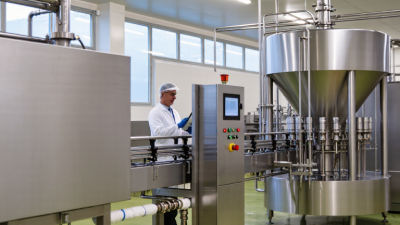
Used for milk, cream, cultured products, and other liquid dairy products. Selection depends on container format, fill volume, required shelf life, line speed, product viscosity, and sterile or hygienic processing conditions.
|
Install in a controlled hygienic zone with smooth, cleanable surfaces, filtered air where required, suitable drainage, and separated personnel and material flows. Provide correct utilities, format-change space, packaging-material storage, and access to critical sealing components.
|
Inspect filling nozzles, seals, pumps, sensors, conveyors, coding systems, and sealing jaws. Verify fill-weight accuracy, package seal integrity, cleaning effectiveness, and changeover performance. Replace wear parts before they create contamination or leakage risks.
|
Guard moving parts, conveyors, hot sealing surfaces, and pneumatic systems. Use emergency stops, safe access platforms, and lockout/tagout. Control broken packaging, sharp edges, compressed air, and chemical exposure during sanitation.
|
Maintain packaging specifications, fill-weight checks, seal-integrity results, traceability records, allergen controls, environmental monitoring where applicable, and food-contact declarations for packaging materials.
|
| Yogurt or Cultured-Product Processing Line |
Fermentation
Incubation
Cooling
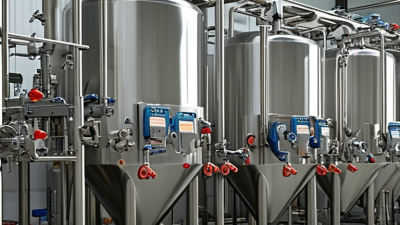
Includes mix preparation, heat treatment, culture dosing, incubation, cooling, and filling. Process parameters vary by culture and product style; temperature, acidity, residence time, and cooling profile must be validated for each recipe.
|
Provide hygienically designed tanks with agitation, accurate temperature control, sanitary culture-addition points, and controlled transfer to filling. Separate raw-material and post-pasteurization areas to reduce cross-contamination.
|
Verify tank probes, agitators, dosing accuracy, cooling performance, pH meters, and transfer hoses. Clean and sanitize between batches, especially after allergen-containing recipes. Calibrate pH and temperature instruments at defined intervals.
|
Control hot-water, steam, pressurized-tank, and chemical-cleaning hazards. Use hygienic zoning, controlled personnel movement, and validated allergen changeover procedures. Protect cultures from unintended contamination.
|
Maintain batch records for culture lot, inoculation conditions, incubation temperature, pH or acidity, cooling time, and release checks. Labeling must address allergens and local compositional requirements.
|
| Refrigeration and Cold-Room System |
Product cooling
Cold storage
Temperature monitoring
Supports cooling of milk, cream, cultured products, and finished goods. Capacity must account for product load, heat ingress, pull-down time, ambient conditions, door openings, and required storage temperature.
|
Provide insulated rooms, hygienic floors, adequate air circulation, correctly sized evaporators and condensers, condensate drainage, and calibrated temperature monitoring. Keep refrigerant equipment accessible and separate from exposed product where practical.
|
Clean evaporator coils and drains, inspect door seals, check refrigerant performance, verify defrost cycles, and calibrate temperature sensors. Record temperatures continuously or at a defined frequency, with alarms for deviations.
|
Protect workers from cold stress, moving fans, electrical hazards, refrigerant leaks, and entrapment. Provide internal door releases and suitable emergency procedures for cold rooms. Only qualified personnel should service refrigeration circuits.
|
Keep temperature maps, alarm tests, maintenance records, refrigerant-management documentation, and corrective-action reports. Refrigerant selection and handling must comply with applicable environmental and occupational-safety regulations.
|
| Hygienic Pumps, Valves, and Piping |
Product transfer
Process control
Drainability
Includes centrifugal pumps, positive-displacement pumps, mix-proof valves, control valves, sanitary tubing, and hygienic fittings. Selection depends on viscosity, shear sensitivity, flow rate, pressure, temperature, and cleaning method.
|
Design piping with appropriate slope, minimal dead legs, accessible supports, correct flow direction, and complete drainability. Use compatible elastomers and stainless-steel product-contact materials. Avoid unnecessary threaded connections in product circuits.
|
Inspect seals, valve seats, diaphragms, bearings, clamps, welds, supports, and instrument connections. Check pump performance and valve sequencing. Conduct preventive replacement of elastomers and verify that cleaned circuits remain free of residue.
|
Guard couplings and rotating shafts, control pressure and water hammer, and provide isolation valves for maintenance. Apply lockout/tagout and depressurization before opening any product or utility connection.
|
Retain hygienic-design drawings, weld and surface-finish records where required, material certificates, elastomer declarations, calibration records, and maintenance history. Applicable hygienic-design guidance may include recognized dairy-industry or food-equipment standards.
|