How to Choose Food Factory Equipment for Your Business?
Choosing food factory equipment is a practical decision with long-term consequences. The right machine must protect product quality, support safe production, and fit your actual workflow. A polished brochure is not enough.
Industry data shows why this choice matters. The Food and Agriculture Organization reports that 13.2% of food is lost between harvest and retail. Equipment that reduces spills, damage, and temperature variation can help limit avoidable waste. The World Health Organization also estimates that contaminated food causes about 600 million illnesses worldwide each year. Hygienic design is therefore a production requirement, not a marketing feature.
Start with your product and process. A dairy line may require precise cooling, clean-in-place systems, and stainless-steel contact surfaces. A bakery may need accurate dosing, gentle conveying, and dependable oven controls. PMMI industry research identifies automation, labor constraints, flexibility, and sustainability as major packaging and processing investment drivers. These pressures affect both small workshops and high-volume plants.
Capacity must be realistic. Calculate peak demand, changeover time, maintenance windows, and future product variations. A machine running at maximum speed all day may look efficient, but it can create costly downtime. Energy use matters too. Check motor efficiency, compressed-air demand, water consumption, and spare-parts availability.
No checklist is perfect. Operators often notice problems engineers miss. Invite them to test access panels, controls, cleaning steps, and noise levels before purchase. Compare verified specifications, supplier service records, and factory acceptance results. The best food factory equipment is not always the fastest option; it is the safest, most maintainable, and most suitable choice for your business.
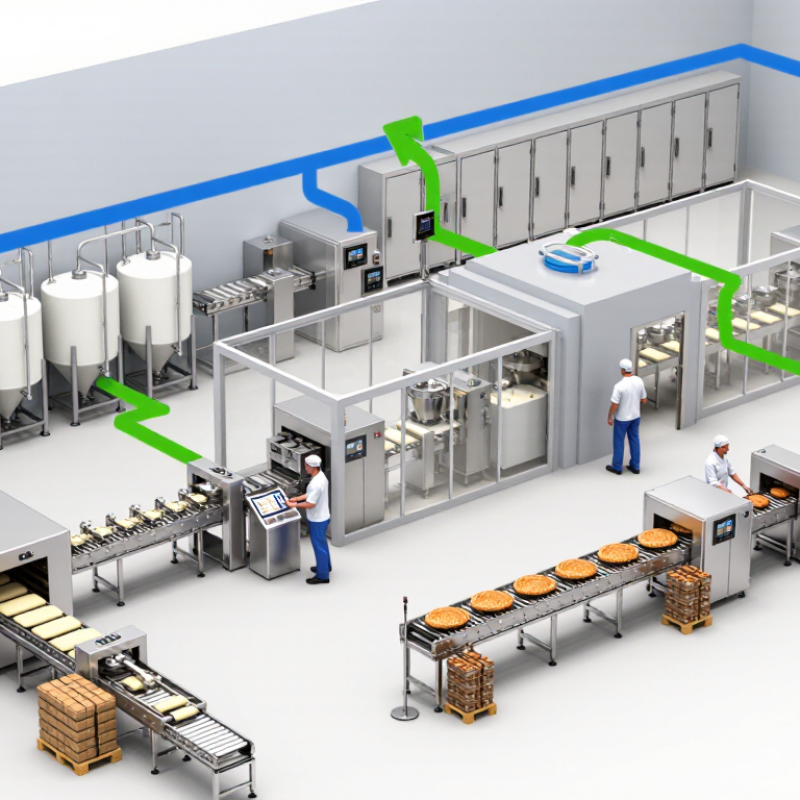
Define Your Food Factory’s Production Goals and Product Requirements
How to Choose Food Factory Equipment for Your Business?
Define Your Food Factory’s Production Goals and Product Requirements
Equipment selection should begin with the product, not the machine catalogue. Define daily output, batch size, texture, moisture, temperature, and packaging format. A sauce line may require gentle pumping, while frozen vegetables need fast chilling and controlled airflow. Record target production in kilograms per hour, including realistic changeover and cleaning time. A spreadsheet is useful, but it can still hide poor assumptions.
The FAO’s State of Food and Agriculture 2019 reported that 14% of food is lost between harvest and retail. This makes accurate handling and storage requirements important. The UNEP Food Waste Index Report 2024 estimated 1.05 billion tonnes of food waste in 2022. Your equipment should reduce overfilling, product damage, and unnecessary rejects. Measure these risks before choosing capacity. Bigger is not always better.
Leave room for testing.
Ask suppliers for trial runs using your actual ingredients. Check viscosity changes, particle size, heating time, and cleaning results. Codex food hygiene principles support hygienic design, cleanable surfaces, and controlled contamination risks. Also calculate water, energy, labor, and maintenance needs. A low purchase price may create expensive downtime later. I would challenge one common assumption: future growth does not always justify oversized equipment. Excess capacity can reduce efficiency today. Review production forecasts honestly, then select equipment that matches verified requirements and measurable quality targets.
How to Choose Food Factory Equipment for Your Business?
Define your production goals and product requirements before selecting equipment. The chart shows practical planning targets for different food product categories.
Use target throughput, product handling needs, and process consistency as key criteria. Equipment should be sized for the required hourly output while allowing sufficient capacity for cleaning, changeovers, and future growth.
Assess Equipment Types, Capacity, Materials, and Processing Functions
How to Choose Food Factory Equipment for Your Business?
When choosing food factory equipment, start with the product, not the catalogue.
A mixer suits sauces, while a cutter may better serve prepared vegetables. Heating, cooling, filling, and sealing require different process controls. Map each production step before contacting suppliers. This simple exercise can expose unnecessary machines.
Capacity needs careful calculation.
Estimate daily output, batch size, operating hours, and cleaning time. A machine rated for ten tonnes may perform poorly at a small batch volume. An undersized unit creates queues and rushed operators. Oversized equipment wastes floor space and energy.
I once saw a factory plan around peak demand only. Most weeks, the machine stood idle. A flexible design would have been wiser.
Material selection affects hygiene and service life.
Food-contact surfaces should resist corrosion, staining, and repeated washing. Inspect smooth welds, accessible corners, seals, and drainage points. Stainless steel is common, but its grade must match the product and cleaning chemicals.
Ask for material records and testing evidence. Do not rely on polished photographs. Processing functions also deserve practical trials. Test the real ingredients, including thick mixtures, sticky fillings, or fragile pieces.
Measure temperature uniformity, product loss, noise, and cleaning time. Operators often notice problems engineers miss. Their feedback may be inconvenient, but it is valuable.
Safety controls, maintenance access, spare-part availability, and clear operating instructions
should influence the final decision.
Compare Automation Levels, Energy Use, and Workplace Safety Features
Choosing food factory equipment starts with the work, not the machine catalogue.
Map each process by volume, product variation, and cleaning frequency. High automation can improve consistency, but it may reduce flexibility when recipes change. The International Federation of Robotics reported over 540,000 industrial robots installed worldwide in 2023. That figure shows momentum, not a universal answer. A smaller plant may need semi-automatic filling and manual inspection instead.
Energy figures deserve equal attention.
The U.S. Department of Energy reports that compressed-air systems can waste 20% to 30% of their output through leaks and poor controls. Select variable-speed compressors, insulated hot-water lines, and motors matched to real loads. Measure energy per kilogram of finished product. A machine with a lower purchase price can quietly become expensive during every shift. I have seen theoretical savings disappear when operators bypass sensors during busy cleaning periods.
Safety features should be tested on the factory floor.
The International Labour Organization estimated 2.93 million work-related deaths globally in 2019, including deaths from occupational diseases. Interlocked guards, emergency stops, lockable isolation points, and clear access paths are practical controls. Ask workers whether buttons remain reachable while wearing gloves. Check whether washdown procedures can damage sensors. Good specifications can still fail in real use. Review maintenance access, noise levels, heat exposure, and training time before approving the equipment. Record baseline energy, downtime, and near-miss data for comparison after installation.
Calculate Total Ownership Costs and Select the Right Equipment Configuration
Choosing food factory equipment should begin with total ownership cost, not the purchase price. A low-cost machine may require expensive installation, extra operators, or frequent cleaning. Calculate energy, water, labor, maintenance, spare parts, training, and expected downtime. Include commissioning and future disposal costs. My early estimates often missed product changeover time. That mistake affected daily output more than the machine price.
Build a five-year cost model for each configuration. Record hourly capacity, utility consumption, staffing, cleaning duration, and maintenance intervals. Ask suppliers for test data, service response times, and written assumptions. Verify critical figures through product trials. Keep the calculations transparent. A spreadsheet is useful, but it can still hide weak estimates. Add a realistic contingency for installation delays and process changes.
Select the configuration around your actual production pattern. A modular line may suit seasonal demand better than a fully automated system. Match contact surfaces, temperature control, dosing accuracy, and cleaning access to the product. Leave safe space around inspection points and service panels. Compare manual, semi-automatic, and automatic options using cost per finished unit. The fastest line is not always the most profitable. An oversized system can waste energy and remain underused. Review the layout with operators and maintenance staff before approval. Their practical experience often reveals awkward access, long walking routes, or difficult sanitation steps. Recheck every assumption before signing.